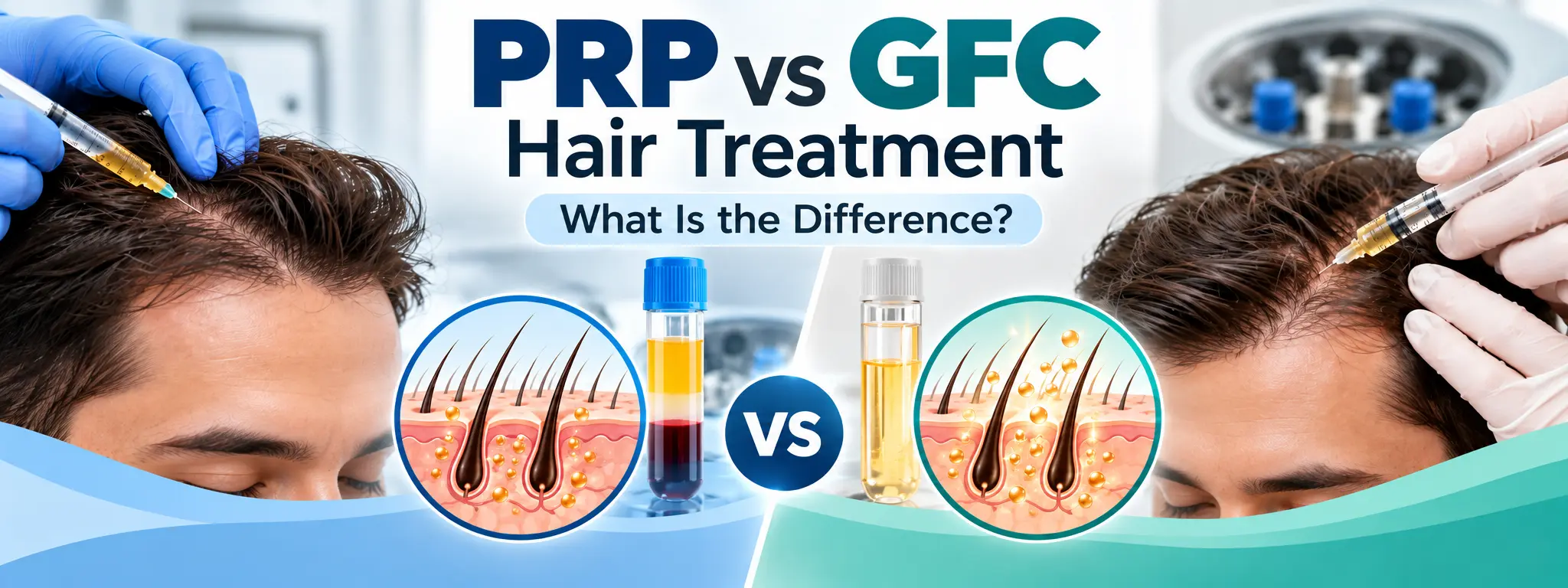
You've probably heard it already. One clinic pushes PRP, another says GFC is the newer option and works better. Now you're sitting with thinning hair and no idea who to believe.
Here's the short version. PRP treatment for hair in India and GFC hair treatment in India both use your own blood to stimulate weak follicles. What changes is how that blood is processed. At Regibloom Wellness, patients ask us about this in almost every first consultation, so let's go through it properly.
PRP concentrates platelets from your blood and injects them into the scalp. GFC uses a dedicated system to collect a concentrated growth factor layer with fewer blood cells. Both are autologous. PRP has more research behind it, GFC has less, and results vary from person to person.
What Is PRP Treatment for Hair in India and How Does It Work?
PRP (platelet rich plasma) is an autologous treatment. A small amount of your blood is spun in a centrifuge so the platelets concentrate in the plasma, and that plasma is injected into the thinning areas of your scalp to stimulate weakened follicles.
The steps are simple. Blood is drawn from your arm, spun, and the platelet-rich layer is separated out. It's then injected across the scalp, sometimes after scalp micro-needling with a dermaroller. The platelets release growth factors, which may extend the growth phase of the follicle and improve the blood supply around it. That's the idea behind PRP for hair growth.
Reviews in dermatology journals generally report some improvement in hair density in androgenetic alopecia. But the protocols differ so much between studies that firm conclusions are hard.
Platelet rich plasma therapy in India is now offered almost every where. That's convenient, but quality isn't the same everywhere. Two clinics can both say "PRP" and deliver very different platelet concentrations. Hold on to that thought, because it matters again below.
What Is GFC Hair Treatment and How Is It Made?
GFC stands for Growth Factor Concentrate. It's also made from your own blood, but with a dedicated centrifuge system designed to collect a concentrated growth factor preparation with very few red and white blood cells.
Growth Factor Concentrate for Hair in India is usually prepared in a closed kit, often without the anticoagulant used in regular PRP tubes. The blood goes through a set spin protocol, the growth factor layer is collected, and it's injected into the scalp much like PRP. Exact steps depend on the machine, so ask your clinic which one they use.
Now the honest part. GFC is newer, and the published data on hair loss is thinner than what exists for PRP. It looks promising. It isn't proven to be better.
PRP vs GFC Hair Treatment in India: What Is the Actual Difference?
The main difference is how the preparation is made, not what it's meant to do. PRP is platelet-rich plasma, often made with an anticoagulant and sometimes in two spins. GFC follows a fixed single-system protocol aimed at a purer growth factor concentrate. Neither is proven better for every patient.
| Factor | PRP | GFC |
|---|---|---|
| Source | Your own blood | Your own blood |
| Preparation | Centrifuge, usually with anticoagulant; protocol varies by clinic | Dedicated system, usually no anticoagulant |
| Concentration | Depends heavily on kit and technique | Designed to be more standardised |
| Procedure time | About 30-60 minutes | About 30-60 minutes |
| Discomfort | Mild to moderate | Mild to moderate |
| Sessions | Usually a course of several | Usually a course of several |
| Downtime | Little; redness for a day or two | Little; similar |
| Research | More widely studied | Limited so far |
| Cost in India | Varies by clinic and kit | Often higher than basic PRP |
So does the name matter? Less than people think. A well-prepared PRP can beat a badly handled GFC session, and the reverse is true too. The kit, the technique and the doctor decide most of the result. Before comparing further, check whether either one suits your kind of hair loss.
Who Should Get PRP or GFC Hair Treatment, and Who Should Skip It?
Hair problems where they can help?
Both work on hair that's thinning but still alive. That means early androgenetic alopecia with miniaturised follicles, diffuse thinning, and a hairline that has just started to recede. Shedding after illness, fever or pregnancy (telogen effluvium) is another case, though many of these settle on their own once the trigger is treated.
Where they won't help?
A smooth, shiny scalp with no visible follicles won't respond. Scarring alopecia, where follicles are destroyed, won't either. And if your thyroid, iron or hormones are off and untreated, an injection can't make up for that.
Who should avoid it?
Skip treatment if you have a blood disorder, a low platelet count, an active scalp infection, or you're pregnant or on active cancer treatment. If you take blood thinners, don't stop them on your own. Your doctor will decide.
One more thing clinics rarely explain. Even good candidates sometimes get weak results. In consultations, the usual reasons are low ferritin, vitamin D deficiency, thyroid problems, PCOS, heavy stress and crash diets. Fixing those often matters as much as the procedure itself.
What Happens During PRP or GFC Treatment, and When Do Results Show?
At Regibloom Wellness, the first visit is a conversation, a scalp examination and usually blood tests for thyroid, ferritin and vitamin D. If a clinic quotes you a package within two minutes without looking at your scalp, be careful.
A typical session goes like this:
- Scalp cleaning and numbing cream
- Blood draw from the arm
- Spinning the blood to prepare PRP or GFC
- Injection into the scalp, with or without micro-needling
- Aftercare instructions
A common course is three to four sessions about a month apart, then maintenance every six to twelve months. Plans differ from person to person, so treat that as a rough guide.
On timing, be realistic. Shedding usually eases first, often around six to eight weeks. Density improves more slowly, over three to six months. Some people see only a modest change. Nothing is guaranteed, and if you stop maintenance, the underlying cause tends to catch up.
Are There Side Effects? How Safe Are PRP and GFC?
Both use your own blood, so allergic reactions are unlikely. The usual effects are mild swelling, redness, scalp tenderness or a headache for a day or two. Infection is rare but possible.
That's why the setting matters. Single-use kits, sterile technique and a qualified doctor are not extras. They're the reason the procedure is safe.
How Much Does PRP and GFC Hair Treatment Cost in India?
PRP hair loss treatment in India has no single price. The cost depends on the city, the clinic, the kit or system, the doctor's experience, the number of sessions and add-ons like micro-needling. GFC is often priced above basic PRP because of the kits involved.
At Regibloom Wellness, PRP & Growth Factor Therapy with Dr B.S. Rajput is priced at ₹55,000. Ask what's included in any quote you get. A very low price can mean shortcuts somewhere, so don't pick on price alone.
What Mistakes Do Patients Make With PRP and GFC (Myths vs Facts)?
The mistakes we see most often:
- Expecting visible results in two weeks
- Skipping maintenance sessions
- Ignoring diet, thyroid, iron and vitamin D
- Choosing the cheapest clinic
- Going to someone who isn't a qualified practitioner
And the myths that go with them:
Myth: GFC is always better than PRP.
Fact: It depends on preparation quality and your diagnosis.
Myth: PRP can regrow hair on a bald scalp.
Fact: It needs living follicles to work with.
Myth: One session is enough.
Fact: It's a course, followed by maintenance.
How Do You Choose Between PRP and GFC?
Start with a scalp assessment by a dermatologist or trichologist. Then run through this list.
Quick checklist
- Is my hair loss early, with follicles still visible?
- Have my thyroid, ferritin and vitamin D been checked?
- Do I understand this is a course plus maintenance?
- Am I comfortable with the current level of evidence?
When you compare PRP therapy treatment in India across clinics, ask four things. Who performs the procedure? Which kit or system is used? How many sessions are planned, and what is the follow-up? What does the price cover? Honest clinics answer these without hesitation.
FAQs
Is GFC hair treatment better than PRP hair treatment?
Not necessarily. GFC hair treatment aims for a purer growth factor concentrate, but PRP has more research behind it for hair loss. Results with either one depend on how it is prepared, your diagnosis and the doctor performing it.
Is PRP hair treatment painful?
PRP hair treatment causes mild to moderate discomfort, mostly from the scalp injections. Numbing cream helps, and the soreness usually settles within a few hours. GFC feels much the same, since the injection method is similar.
How many sessions of PRP or GFC hair treatment do you need?
Most patients need three to four sessions of PRP or GFC, about a month apart, followed by maintenance sessions. Your doctor decides the exact plan after a scalp assessment.
Is PRP or GFC hair treatment permanent?
No, neither PRP nor GFC gives a permanent result. Both support weak follicles but don't remove the cause of your hair loss, so maintenance sessions are usually needed to hold the improvement.
Can women get PRP or GFC hair treatment?
Yes, women can get PRP or GFC hair treatment. It is often considered for diffuse thinning or post-pregnancy shedding, after thyroid, iron and PCOS are checked.
Does PRP or GFC hair treatment work for baldness?
PRP and GFC do not work on advanced baldness, where the scalp is smooth and has no living follicles. They work best on thinning hair that is still growing. In advanced cases, your doctor may discuss a hair transplant instead.
Is PRP or GFC hair treatment safe?
Yes, PRP and GFC hair treatment is generally safe when done by a qualified doctor, because both use your own blood and allergic reactions are unlikely. Temporary swelling and redness are common, and infection is rare.
How soon do results appear after PRP or GFC hair treatment
Reduced hair shedding after PRP or GFC may show in about six to eight weeks. Better hair density usually takes three to six months, and the response differs from person to person.
Conclusion: Which Treatment Is Right for You?
Choosing between PRP treatment for hair in India and GFC hair treatment in India depends less on the label and more on your diagnosis, the preparation quality and how well you follow through. If you're unsure, start with a scalp assessment. You're welcome to book a consultation at Regibloom Wellness, and we'll go through your options without pressure.
Disclaimer: This article is for education and isn't a substitute for medical advice. Please consult a qualified doctor before starting any treatment.